
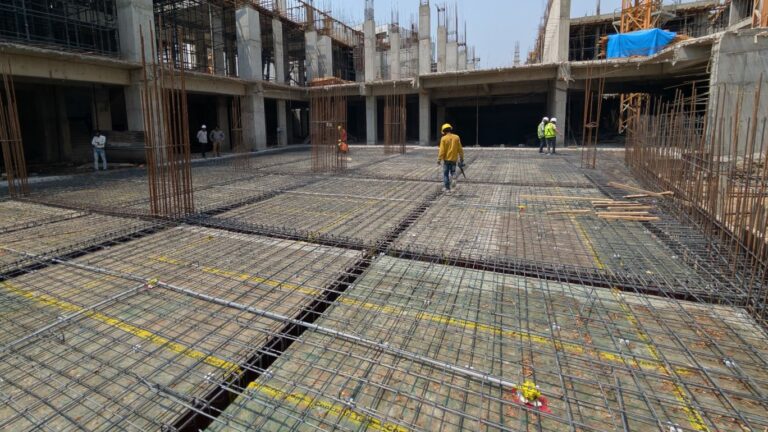
Concrete does not forgive weakness.
In heavy RCC projects, concrete is not just a mixture. It is weight, pressure, vibration, and force contained within a temporary structure called formwork. That temporary structure carries enormous responsibility. If it bends, sags, or shifts, the consequences are visible immediately in the finished structure.
When builders talk about strength, they often focus on steel reinforcement and concrete grade. But rarely do they pause to consider the silent hero holding everything together during casting. The formwork sheets.
In heavy RCC construction, such as high-rise buildings, infrastructure projects, industrial slabs, and thick transfer beams, the load-bearing capacity of formwork materials becomes critical. Choosing the right formwork boards and formwork panels is not just about cost. It is about safety, consistency, and performance under stress.
Let us explore what load-bearing capacity really means in heavy RCC projects, what affects it, and why engineered plastic formwork panels like WoWBoards by WoWMaterials are redefining durability and reliability on-site.
Understanding Load in Heavy RCC Projects
Wet concrete is heavier than most people imagine. A cubic metre of concrete can weigh around 2400 kilograms. Multiply that across large slabs and deep beams, and the pressure exerted on formwork becomes significant.
Load on formwork sheets comes from three sources:
- Dead load of wet concrete
- Impact load during pouring
- Vibrational load during compaction
This load is not static. It shifts as concrete flows and vibrators operate. In heavy RCC projects, especially thick slabs and large columns, the pressure on formwork is intense and sustained.
If the sheets flex or weaken even slightly, it reflects immediately in slab thickness variation or surface defects.
What Determines the Load-Bearing Capacity of Formwork Sheets
Not all durable formwork sheets are created equal. Several factors influence their ability to carry a load effectively.
Material Composition
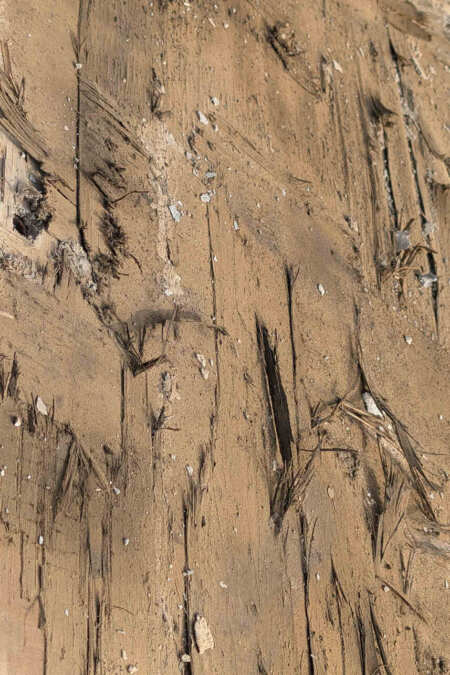
Traditional plywood-based formwork boards rely on layered wood veneers. While strong initially, their strength reduces over time due to moisture exposure and repeated loading cycles.
Steel formwork is strong but heavy and expensive.
Engineered plastic formwork panels offer a balance of strength, durability, and manageable weight.
Thickness and Structural Integrity
Thicker sheets generally provide higher load resistance. However, thickness alone is not enough. Internal structural integrity matters.
Plywood may be thick, but vulnerable to internal delamination. Plastic formwork panels are solid throughout, which improves consistency.
Support Spacing
Even strong sheets require proper support spacing. The stronger the material, the more predictable the support requirements.
When sheets lose stiffness over time, additional props become necessary, increasing labour and cost.
The Problem With Conventional Formwork Plywood in Heavy RCC
Many heavy RCC projects still rely on plywood-based formwork sheets. On the first few uses, performance may seem acceptable.
However, heavy projects demand repetition. Slab after slab. Column after column.
Here is where plywood begins to struggle.
Gradual Loss of Strength
Repeated exposure to moisture weakens internal layers. Even when the surface appears intact, internal strength reduces.
Flexing Under Load
As stiffness decreases, sheets begin to flex slightly under concrete pressure. This leads to sagging in slabs and bulging in beams.
Increased Support Requirements
To compensate for weakening sheets, additional supports are installed. This increases material usage and labour time.
In heavy RCC projects, such compromises accumulate quickly.
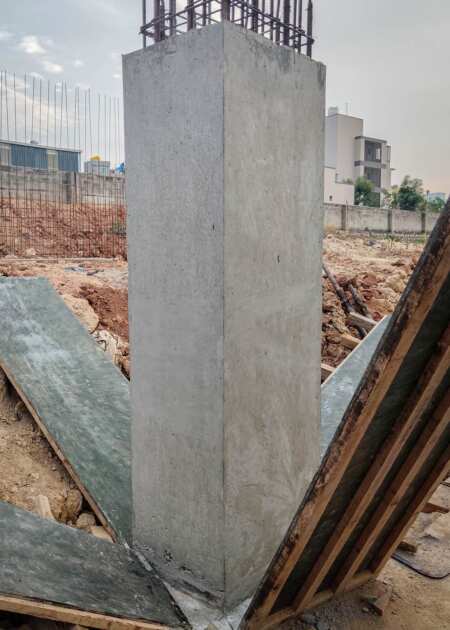
Why Load-Bearing Stability Matters in Column Formwork
Formwork for column applications demands precision. Columns carry vertical loads and must remain dimensionally accurate.
If formwork panels flex outward under pressure, column dimensions increase slightly. This misalignment can compound across floors.
Durable formwork sheets must resist lateral pressure consistently. Even small variations can affect structural alignment and aesthetics.
Plastic formwork panels with high dimensional stability help maintain precise column geometry across repeated cycles.
The Advantage of Engineered Plastic Formwork Panels
Plastic formwork has evolved significantly. Modern formwork materials made from recycled plastic are engineered to withstand high loads without degrading.
WoWBoards formwork panels are designed specifically for construction environments where load-bearing performance must remain consistent over time.
Consistent Structural Integrity
Unlike plywood, which relies on adhesive layers, plastic formwork panels are solid throughout. There are no internal layers to weaken or separate.
Resistance to Moisture-Induced Weakening
Moisture does not affect the structural integrity of plastic sheets. This ensures that load-bearing capacity remains stable even after repeated curing cycles.
High Reusability Without Strength Loss
Heavy RCC projects require materials that can handle dozens of cycles. WoWBoards maintain stiffness and strength over repeated use.
Comparing Load-Bearing Behaviour Over Time
Let us imagine a heavy slab project using traditional plywood and plastic formwork sheets.
Cycle 1: Both perform adequately.
Cycle 5: Plywood shows minor edge wear. Plastic remains stable.
Cycle 10: Plywood begins to flex slightly. Plastic maintains stiffness.
Cycle 20: Plywood requires tighter support spacing. Plastic continues to perform consistently.
This difference is where long-term economics comes into play.
Durable formwork sheets that maintain load-bearing capacity reduce the need for constant adjustments and replacements.
Safety Considerations in Heavy RCC Projects
Load-bearing failure in formwork is not just a quality issue. It is a safety issue.
Unexpected sagging or panel failure can lead to structural defects and on-site hazards.
Choosing stable pvc materials reduces such risks significantly.
WoWBoards provide predictable load performance, which enhances safety margins in heavy RCC applications.
Reducing Hidden Costs Through Better Load Capacity
When formwork sheets flex under load, it leads to:
- Uneven slab thickness
- Additional plastering
- Rework
- Increased prop density
- Higher labour input
These hidden costs often exceed the difference in initial material price.
Durable formwork sheets that maintain structural integrity reduce these recurring expenses.
Sustainability in Heavy RCC Construction
Large RCC projects consume enormous quantities of materials. Plywood-based formwork often becomes waste after a limited number of cycles.
Plastic formwork panels like WoWBoards are made from recycled plastic and are recyclable at the end of their lifecycle.
This reduces environmental impact while improving load performance.
In modern construction, strength and sustainability must coexist.
Practical Benefits for Project Managers
For project managers handling heavy RCC projects, predictability is everything.
Knowing that your formwork sheets will behave the same way on the twentieth slab as they did on the first simplifies planning.
WoWBoards offer:
- Consistent stiffness
- Reduced need for additional supports
- Reliable performance in column and slab applications
- Longer usable life
These practical benefits translate into smoother project execution.
Conclusion: Load Bearing Is Not a One-Time Test
In heavy RCC projects, load bearing capacity is not tested once. It is tested repeatedly.
Materials that weaken gradually create uncertainty. Materials that maintain strength build confidence.
Traditional plywood-based formwork boards may work initially, but struggle to maintain performance across cycles.
WoWBoards formwork panels by WoWMaterials are engineered to deliver consistent load-bearing capacity under demanding conditions.
They are durable formwork sheets designed for heavy RCC work, not light-duty applications.
Choose Strength That Lasts With WoWBoards
If your project involves heavy slabs, thick beams, or repetitive column casting, do not compromise on formwork strength.
Upgrade to WoWBoards formwork panels by WoWMaterials.
Higher durability. Consistent load capacity. Better long-term economics.
In heavy RCC projects, strength should not fade with repetition. It should stay solid from the first pour to the final cycle.