
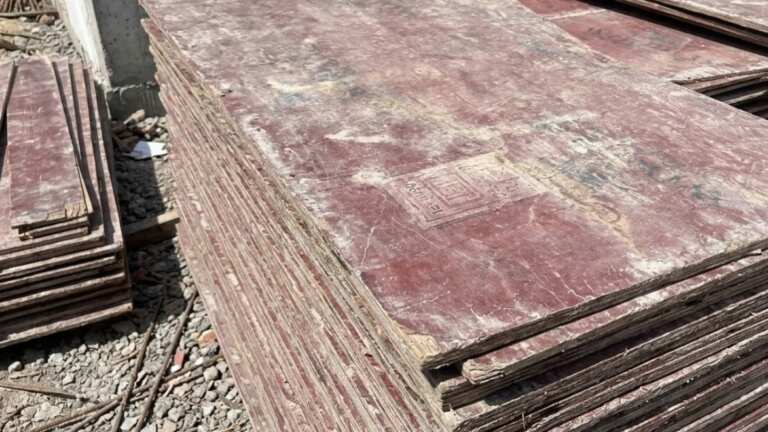
Every construction site has a moment of disbelief.
A stack of waterproof plywood arrives. It looks strong. It feels solid. Someone checks the invoice and nods with satisfaction because the price reflects quality. The assumption is simple. This board is waterproof. It should survive curing water, rain, and repeated use.
Then two weeks later, the edges swell. The surface begins to change. Alignment looks slightly off. The slab that should have been perfectly flat starts showing minor undulations.
The first reaction is usually frustration. Someone says the plywood must be low quality. Someone else blames the supplier. But the truth is more complicated.
Many cases of swelling in water proof plywood are not just about product quality. They are about how materials behave on real construction sites and how certain site level practices unintentionally accelerate failure.
Understanding why swelling happens helps builders make better choices about shuttering boards, storage practices, and eventually about moving toward more reliable alternatives such as plastic shuttering systems like WoWBoards by WoWMaterials.
Let us explore the real reasons waterproof plywood swells and what builders can do about it.
The Misunderstanding Behind Waterproof Plywood
The phrase waterproof plywood often creates the impression that the board is immune to water. In reality, the term usually refers to the adhesive used between plywood layers.
The glue may resist moisture. The wood fibres do not.
Plywood is made from thin veneers of wood bonded together. Wood naturally absorbs moisture. When it does, the fibres expand. That expansion is what we see as swelling.
Even the best waterproof ply board cannot completely stop moisture from entering if the conditions on site allow water to reach the inner layers.
This is why many builders who invest in high grade plywood still encounter swelling problems.
Mistake One: Ignoring the Edges
Most swelling begins at the edges of shuttering plywood.
When boards are cut on site, the edges become exposed. The protective surface film or treatment is no longer present at those points. Water enters easily.
Once moisture enters through the edge, it travels along the grain of the wood layers. The swelling spreads gradually across the board.
Many sites focus on protecting the surface but forget that the edges are the most vulnerable areas.
Repeated wetting and drying cycles accelerate this problem.
Mistake Two: Storing Boards on Damp Ground
Storage conditions matter more than many people realise.
On busy sites, stacks of shuttering boards are often placed directly on the ground. During monsoon or even normal curing cycles, the soil remains damp.
Wood absorbs moisture through capillary action. Boards placed on damp ground slowly absorb moisture from below even before they are used.
By the time the plywood reaches the shuttering stage, swelling has already begun internally.
Even if the boards look dry from the outside, internal moisture can cause dimensional changes during the next cycle.
Mistake Three: Continuous Exposure to Curing Water
Concrete curing requires water, and plenty of it. Slabs are kept wet for days.
This water often flows across shuttering surfaces repeatedly. While water proof plywood can resist occasional moisture, prolonged exposure overwhelms the protective layers.
Water finds entry through screw holes, joints, and edges.
Once inside, the wood fibres expand and the board loses its original shape.
In heavy RCC projects where repetition is high, this exposure repeats again and again. Swelling becomes inevitable.
Mistake Four: Excessive Nail and Screw Holes
Shuttering assembly often requires nails, screws, or fasteners.
Every hole created in the board is a potential entry point for moisture.
Over repeated cycles, the number of holes increases. Water enters through these openings and travels into the internal layers.
This is particularly common in projects where boards are reused frequently without proper sealing or repair.
The result is internal damage that may not be visible until the board begins to warp.
Mistake Five: Rough Handling During Dismantling
During dismantling, boards are often pried loose using crowbars or hammers. Small cracks and chips appear along the edges and surfaces.
These tiny damages expose the wood fibres directly to moisture.
The next time the board is used, water enters these areas easily.
Even if the waterproof plywood price is high, rough handling on site can reduce its lifespan dramatically.
Mistake Six: Reusing Boards Beyond Their Capacity
Every material has a lifecycle. Shuttering plywood is no exception.
After several cycles of exposure to moisture, pressure, and vibration, the structural integrity of the board begins to decline.
However, in an effort to reduce costs, boards are sometimes used far beyond their safe limits.
By this stage, swelling, warping, and surface degradation become unavoidable.
Concrete finish suffers, and alignment issues appear.
The Hidden Cost of Swelling
Swelling in waterproof ply board is not just a cosmetic problem.
It leads to several practical issues on site:
- Uneven slab surfaces
- Bulging columns
- Increased plastering requirements
- Additional labour for correction
- Reduced reuse cycles
These hidden costs accumulate over the course of a project.
Even if the water proof ply price appears economical initially, repeated replacements and rework increase the overall cost.
Why Plastic Shuttering Solves the Root Problem
The fundamental reason plywood swells is simple. It is made of wood.
Plastic does not behave the same way.
A plastic shuttering board does not absorb moisture. There are no wood fibres to expand. There are no internal layers that delaminate.
Rain, curing water, and humidity do not affect the dimensional stability of plastic.
This single property eliminates the most common cause of swelling in shuttering materials.
How WoWBoards Change the Equation
WoWBoards by WoWMaterials are engineered plastic formwork panels designed specifically for construction environments.
They are not coated plywood. They are not treated wood. They are solid plastic boards built to withstand moisture, load, and repetition.
Moisture Immunity
WoWBoards do not absorb water. Even in heavy monsoon conditions or prolonged curing cycles, their dimensions remain stable.
Consistent Shape
Because they do not swell, alignment remains accurate. Slabs and columns maintain precise dimensions.
Longer Reuse Life
Plastic shuttering boards maintain strength across many cycles. Contractors often report significantly higher reuse compared to plywood.
Better Concrete Finish
Plastic surfaces remain smooth over time. Concrete does not stick easily, which helps maintain consistent finish quality.
The Shift Happening on Construction Sites
Many builders initially adopt plastic formwork cautiously. They test it on a few slabs or columns.
Over time, the advantages become clear.
Fewer boards are rejected.
Surface finish improves.
Rework reduces.
Material planning becomes easier.
This is why plastic shuttering boards like WoWBoards are increasingly replacing traditional shuttering plywood in repetitive construction work.
Choosing Materials That Match Site Reality
Construction sites are unpredictable environments.
There is rain, humidity, curing water, rough handling, and constant reuse.
Materials that rely on controlled conditions struggle to survive here.
Materials designed for real site conditions perform better.
Plastic formwork panels are designed for this reality.
Conclusion: Swelling Is a Material Problem, Not Just a Site Problem
Site level mistakes can accelerate swelling in waterproof plywood, but the root cause lies in the material itself.
Wood absorbs moisture. No amount of treatment can completely prevent that.
As long as plywood is used for shuttering, swelling will remain a recurring issue.
Plastic shuttering boards eliminate the problem at its source.
WoWBoards by WoWMaterials offer a more stable, durable, and reliable solution for formwork and shuttering work.
Build Without Swelling With WoWBoards
If your site has experienced swelling, warping, or early failure of waterproof plywood, it may be time to rethink the material itself.
Upgrade to WoWBoards plastic formwork panels by WoWMaterials.
No swelling. No surprises. Just consistent performance across cycles.
Your concrete will show the difference.