
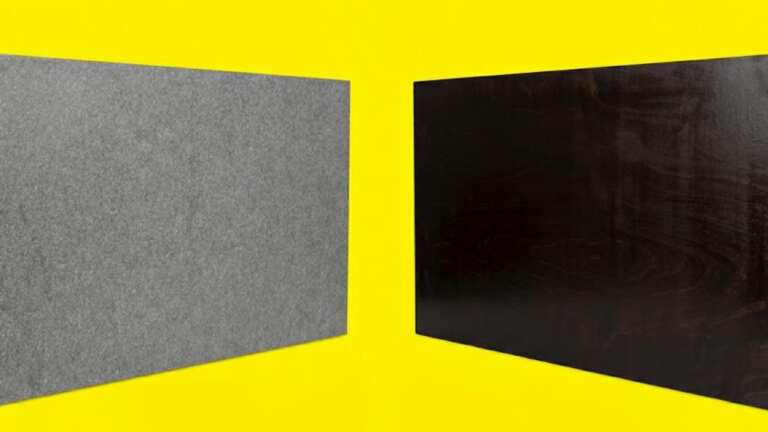
On most construction sites, the debate does not begin with theory. It begins with a stack of boards.
On one side, there is film-faced plywood. Familiar. Trusted. Used for years. The kind of material everyone knows how to handle.
On the other side, there is the newer entrant. The plastic ply board. It looks different. It behaves differently. And for many contractors, it raises one simple question.
Is it actually better?
When it comes to concrete formwork, especially in repetitive projects, this question matters more than ever. Because the choice of shuttering materials directly affects cost, finish quality, and project timelines.
Let us compare plastic plywood and film-faced plywood in real construction conditions and understand which material truly delivers durability and efficiency.
Understanding Film Faced Plywood
Film-faced plywood is a type of waterproof plywood that has a thin film coating on its surface.
This film is designed to:
- Improve surface finish
- Reduce water absorption
- Make demoulding easier
At first glance, it seems like an ideal solution for concrete shuttering boards.
And in the initial cycles, it performs well.
But the keyword here is initial.
What Happens to Film-Faced Plywood Over Time
Construction is not a one-time activity. It is repetitive. Slabs, beams, and columns are cast again and again.
With each cycle, film faced plywood goes through:
- Water exposure during curing
- Pressure from wet concrete
- Vibration from compaction
- Handling during dismantling
Over time, the film layer starts to degrade.
Film Damage
The protective film gets scratched, peeled, or worn out. Once this layer is compromised, the wood beneath is exposed.
Moisture Penetration
Water enters through damaged areas, edges, and nail holes. Even though it is called water proof plywood, the core remains wood.
Wood absorbs moisture. Swelling begins.
Delamination
Repeated wetting and drying cycles weaken the adhesive bonds between layers. This leads to delamination.
Reduced Performance
The board that once provided a smooth finish begins to lose its consistency.
Concrete starts sticking. Surface quality drops. Rework increases.
The Core Limitation of Film Faced Plywood
The limitation is not the film. It is the material underneath.
Film-faced plywood is still plywood.
No matter how good the coating is, once it wears out, the board behaves like regular wood-based shuttering boards.
This is where durability becomes a challenge.
Enter Plastic Ply Boards
A plastic ply board is fundamentally different.
It does not rely on a surface coating for protection. It does not depend on adhesive layers for strength.
It is a solid material designed for construction applications.
This difference changes everything.
How Plastic Ply Boards Perform in Concrete Formwork
No Dependence on Surface Coating
Unlike film-faced plywood, plastic plywood does not need a protective layer.
The entire board is made from the same material. Even if the surface gets scratched, performance does not change.
Complete Moisture Resistance
Plastic does not absorb water.
This means:
- No swelling
- No warping
- No dimensional change
In concrete formwork, where water is unavoidable, this is a major advantage.
Consistent Strength
Plastic boards do not have layers that can separate.
There is no delamination. Structural integrity remains intact across cycles.
Smooth Surface Across Reuse
The surface of plastic boards remains consistent.
Concrete does not stick easily, which helps maintain finish quality over multiple uses.
Comparing Performance in Real Conditions
Let us look at how both materials behave over time.
Cycle 1
Film-faced plywood delivers a good finish.
Plastic ply board delivers similar or better performance.
Cycle 5
Film begins to show wear.
Plastic board remains unchanged.
Cycle 10
Plywood starts absorbing moisture. Swelling may begin.
Plastic board continues stable performance.
Cycle 20
Plywood requires replacement.
Plastic board continues to function.
This difference defines durability.
Cost Comparison Beyond Price Tags
The waterproof plywood price or film-faced plywood cost may seem attractive at the beginning.
But the real cost is determined by:
- Number of reuse cycles
- Replacement frequency
- Labour for rework
- Surface finishing cost
Plastic boards may have a higher initial cost, but their longer lifespan reduces cost per use significantly.
In repetitive construction, this difference becomes substantial.
Handling and Storage on Site
Film-faced plywood requires careful handling.
- It must be stored away from moisture
- Edges need protection
- Surface damage must be avoided
Even with careful handling, wear is inevitable.
Plastic shuttering boards are more forgiving.
- They can be stored outdoors
- They are less sensitive to moisture
- Surface damage does not affect performance significantly
This simplifies site operations.
The Role of Plastic Shuttering Materials in Modern Construction
As construction becomes more demanding, materials are expected to perform consistently under stress.
Plastic shuttering materials meet these expectations because they are designed for:
- Repetition
- Moisture exposure
- Load bearing
They reduce dependency on ideal site conditions.
This makes them more reliable in real-world scenarios.
Why WoWBoards Stand Out
Among plastic options, WoWBoards by WoWMaterials have been engineered specifically for concrete formwork.
They are not generic plastic sheets. They are purpose-built concrete formwork sheets.
Designed for Durability
WoWBoards maintain strength and shape across multiple cycles.
They do not degrade like film-faced plywood.
Stable in All Conditions
Whether it is rain, curing water, or humidity, WoWBoards remain unaffected.
Consistent Finish Quality
The surface remains smooth, helping achieve a better concrete finish.
High Reuse Potential
Contractors often report significantly higher reuse cycles compared to traditional plywood-based boards.
Sustainability Advantage
Traditional concrete shuttering boards made from plywood rely on timber resources.
Plastic boards like WoWBoards are made from recycled materials.
This reduces environmental impact and supports sustainable construction practices.
Why Contractors Are Making the Shift
The shift from film-faced plywood to plastic ply boards is not driven by trends.
It is driven by experience.
Contractors see:
- Reduced material failure
- Better finish quality
- Lower long-term cost
- Easier handling
Once they experience consistent performance, the decision becomes clear.
Choosing the Right Material for Your Project
If your project involves repetitive concrete work, the choice of shuttering materials becomes critical.
The right material should:
- Maintain shape under load
- Resist moisture completely
- Deliver a consistent finish
- Last across multiple cycles
Plastic ply boards meet these requirements more effectively than film-faced plywood.
Conclusion: Durability Is About What Happens After the First Use
Film-faced plywood performs well in the beginning. But its dependence on a surface coating limits its durability.
Once the film is damaged, performance declines.
Plastic ply boards do not rely on coatings. They are designed for long-term use.
WoWBoards by WoWMaterials offer durability, consistency, and efficiency that traditional plywood struggles to match.
In repetitive construction, that difference matters.
Build Better with WoWBoards
If you are looking for formwork panels that can handle moisture, pressure, and repetition without losing performance, it may be time to upgrade.
Choose WoWBoards plastic shuttering panels by WoWMaterials.
More durability. Better finish. Lower long-term cost.
Because in construction, the real test of a material is not how it performs once. It is how it performs every time.